Is Valentine’s Day Celebrated in China? A Complete Guide
Every February, lovers worldwide mark February 14 as Valentine’s Day. But across China’s vast provinces, the question often arises: is Valentine’s Day celebrated in China?
The answer is a resounding yes—albeit with unique twists.
Modern Chinese couples observe the Western holiday, while ancient lunar-calendar festivals like Qixi and the Lantern Festival offer homegrown avenues for romance.
This guide unpacks history, customs, and local variations, so you can navigate China’s season of love.
Western Valentine’s Day in China
History of February 14 in China
Imported in the late 1980s and early 1990s, Western Valentine’s Day arrived alongside economic reforms and the opening of global trade.
International brands like Cartier, Hallmark, and local florists began promoting red roses, “love locks,” and heart-shaped chocolates.
By the 2000s, department stores in Beijing, Shanghai, and Guangzhou held elaborate in-store events featuring live music and gift booths.
Modern Celebrations and Customs
Today, February 14 is firmly planted on China’s commercial and social calendar.
Typical customs include:
- Exchanging bouquets of red roses, with “12 for love” or “99 for forever.”
- Romantic dinners at upscale hotels or themed restaurants.
- Sharing couple photos on WeChat Moments or Douyin with Valentine’s hashtags.
- Shopping for limited-edition gifts like jewelry, lingerie, or personalized keepsakes.
Young urbans often book tables weeks in advance, while malls curate Valentine’s pop-up markets.
Hotels report room-occupancy spikes as high as 90% in major cities.
Chinese Valentine’s Days
While February 14 has gained momentum, China’s own lunar holidays dedicated to love date back centuries.
In fact, there are at least three traditional “Valentine’s Days” in China.
Qixi Festival (Double Seventh Festival)
- Date: 7th day of the 7th lunar month
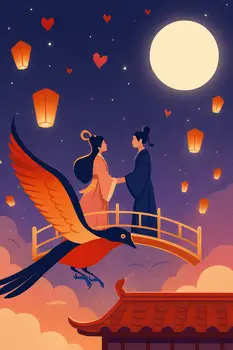
- Origin: Legend of Niulang and Zhinü, the Weaver Girl and the Cowherd, separated by the Milky Way; they meet once a year on a magpie bridge.
- Customs:
- Young women demonstrate weaving and needlework, symbolizing devotion.
- Couples stargaze, hoping to glimpse the Vega–Altair alignment.
- Handcrafted gifts like paper magpies or grass-themed items.
- Status: Widely celebrated as China’s equivalent to Valentine’s Day, with themed events in parks and shopping districts.
Other “Valentine’s” Festivals: Lantern & Shangsi
| Festival Name | Lunar Date | Origin & Customs |
|---|---|---|
| Lantern Festival | 15th day of 1st lunar month | Lantern riddles; tangyuan (glutinous rice balls); young women meet suitors in public lantern displays. |
| Shangsi Festival | 3rd day of 3rd lunar month | Originally a purification and spring-outing festival by water’s edge, offering courtship opportunities. |
Comparing China’s Love Festivals
| Feature | Western Valentine’s Day | Qixi Festival | Lantern Festival | Shangsi Festival |
|---|---|---|---|---|
| Calendar | Gregorian (Feb 14) | Lunar (7/7) | Lunar (1/15) | Lunar (3/3) |
| Origin | Christian St Valentine | Myth of Weaver & Cowherd | Ancient lantern appreciation | Spring water purification |
| Main Gifts/Activities | Roses, chocolates, dinner | Handmade crafts, stargazing | Lantern riddles, tangyuan | Spring outings, poetry |
| Urban vs Rural Popularity | Urban-centric | Nationwide | More regional now | Mostly minority groups |
| Commercialization Level | Very high | Medium | Low | Very low |
Why China Embraces a “Month of Love”
China’s rising middle class has more disposable income and leisure time, fueling demand for celebratory events.
The government’s support of cultural tourism further spotlights traditional festivals, while social media amplifies trends.
Brands have capitalized on this by creating cross-festival campaigns—Valentine’s Day roses sold alongside Qixi-themed magpie accessories, for example—blurring lines between Western and Chinese customs.
Celebrating Valentine’s Day in China Today
For Local Couples
Urban couples often plan elaborate dates:
- Morning: Exchanging breakfast-in-bed delivered by a boutique café.
- Afternoon: Photo sessions at scenic locales—classical gardens or rooftop bars.
- Evening: Candlelit multi-course dinners with pairing of local wines or baijiu.
On social platforms, trending hashtags like #情人节快乐 (Happy Valentine’s) can garner thousands of likes.
Many universities host “Love Corners,” decorated lawns where students confess their feelings through letters and small gifts.
For Expats and Tourists
Foreign visitors can partake by:
- Booking themed Valentine’s events—for instance, rooftop Mandarin classes followed by a sunset toast.
- Visiting temple fairs during Lantern Festival for a blended experience of Chinese and Western romance.
- Attending expat-organized speed-dating nights in Shanghai, often conducted in English and Mandarin.
Travel apps like Ctrip and Meituan list Valentine’s packages, from spa retreats to private yacht charters in Hainan.
Tips for Experiencing Valentine’s Day in China
Gift Ideas and Where to Buy
- Red roses: Available at flower markets such as Beijing’s Panjiayuan or Shanghai’s Huaihai Road florists.
- Qixi crafts: Hand-painted magpie trinkets from artisan stalls in Chengdu’s Jinli Ancient Street.
- Tech gifts: Smart home gadgets—Xiaomi Mi Robot Vacuum or Huawei Watch—sold nationwide.
- Personalized keepsakes: Taobao shops offer custom calligraphy prints combined with engraved jewelry.
Etiquette, Taboos, and Safety
- Never give clocks (钟) or handkerchiefs (手帕); they symbolize “endings” or “farewells.”
- Avoid white or black wrapping paper—red is lucky; yellow can imply jealousy.
- At crowded malls and restaurants on Feb 14, book at least two weeks in advance.
- Beware of pickpockets in festive street markets; secure valuables in inner jackets.
Conclusion
In China, love finds many expressions. Western Valentine’s Day has woven itself into the cultural fabric, coexisting with age-old lunar festivals like Qixi, Lantern, and Shangsi.
Whether you’re strolling beneath paper lanterns, forging handmade magpie crafts, or exchanging roses over sunset cocktails, the question “is Valentine’s Day celebrated in China?” transforms into “how will you celebrate?”
With this guide, you’re ready to explore China’s layered romance—from Beijing’s high-rise date nights to rural Qixi stargazing.
Embrace both Western and Chinese traditions, and your Valentine’s season will span months of heart-warming festivities.
Sources
[1] TravelChinaGuide, “How many Valentine’s Days are there in China? Amazingly Three!” https://www.travelchinaguide.com/essential/holidays/chinese-valentines-day.htm
[2] StudyCLI, “What is Chinese Valentine’s Day and how is it celebrated?” https://studycli.org/chinese-holidays/chinese-valentines-day/
[3] The Helpful Panda, “Chinese Valentine’s Day (and why it’s six times a year)” https://thehelpfulpanda.com/chinese-valentines-day/