🀄 Mandarin Dialects & Regional Variations in China: Guide for Expats
The linguistic landscape of China is far more complex than many realize.
While Mandarin Chinese (普通话, Pǔtōnghuà) is often discussed as a single language with over 1.1 billion speakers worldwide (Ethnologue, 2024), it encompasses a rich tapestry of regional variations that reflect China’s vast cultural and historical diversity.
Understanding Mandarin’s Dialectal Framework
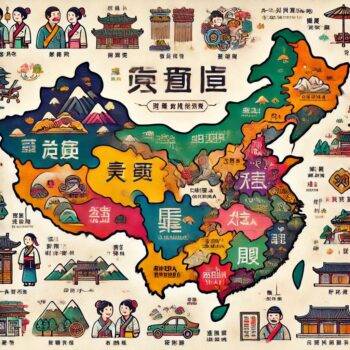
According to the Language Atlas of China (中国语言地图集), Mandarin dialects can be classified into eight major groups:
- Northern Mandarin (北方官话)
- Northwestern Mandarin (西北官话)
- Southwestern Mandarin (西南官话)
- Central Plains Mandarin (中原官话)
- Jianghuai Mandarin (江淮官话)
- Eastern Mandarin (东部官话)
- Jinghuai Mandarin (京淮官话)
- Northeastern Mandarin (东北官话)
Regional Characteristics and Variations
Northern Mandarin
- Geographic Distribution: Beijing, Hebei, parts of Inner Mongolia
- Distinctive Features:
- Forms the basis of Standard Mandarin
- Clear pronunciation of retroflex consonants (zh, ch, sh)
- Example: 这个 (zhège) is pronounced with a distinct retroflex ‘zh’
- Source: Beijing Language and Culture University Studies, 2023
Southwestern Mandarin
- Geographic Distribution: Sichuan, Yunnan, Guizhou, Chongqing
- Population: Approximately 260 million speakers
- Distinctive Features:
- Merging of ‘n’ and ‘l’ sounds
- Simplification of retroflex consonants
- Example: 是 (shì) often becomes (sì)
- Research: Li & Thompson’s “Mandarin Chinese: A Functional Reference Grammar”
Linguistic Features Across Dialects
Phonological Variations
Examples documented by the Chinese Academy of Social Sciences (CASS Linguistics, 2024):
- Tonal Differences:
- Beijing: Four tones clearly distinguished
- Chengdu: Modified third tone patterns
- Example: 买 (mǎi) in Beijing vs. Chengdu pronunciation
- Consonant Variations:
- Standard: 花 (huā)
- Northeastern: (xā)
- Southwestern: (fā)
Lexical Variations
Regional vocabulary differences (Chinese Dialect Database, 2024):
| Meaning | Beijing | Sichuan | Shanghai |
|---|---|---|---|
| Potato | 土豆 (tǔdòu) | 洋芋 (yángyù) | 山芋 (shānyù) |
| Bus | 公共汽车 (gōnggòngqìchē) | 巴士 (bāshì) | 公交车 (gōngjiāochē) |
Cultural Impact and Preservation
The relationship between dialects and local culture is profound.
Research by the Chinese Cultural Heritage Protection Center shows that:
- 70% of traditional opera forms rely on local dialects
- 85% of folk literature is dialect-based
- Local customs and festivals often incorporate dialect-specific elements
Modern Preservation Efforts
Several initiatives are currently working to preserve China’s dialect diversity:
- Digital Archives:
- The Chinese Dialect Preservation Project
- Mobile apps like “方言保护者” (Dialect Protector)
- Academic Research:
- Ongoing studies at Peking University’s Linguistics Department
- International collaboration with institutions like Stanford’s Chinese Linguistics Project
Educational Resources
For those interested in learning more about Mandarin dialects:
- Online Resources:
- Academic Publications:
- “Atlas of Chinese Dialects” (中国方言地图集)
- “Chinese Dialectology” by William S-Y. Wang
Conclusion
Understanding Mandarin dialects is crucial for appreciating China’s linguistic heritage.
While Standard Mandarin serves as a unifying force, regional dialects remain vital repositories of cultural knowledge and local identity.
Their preservation and study contribute significantly to our understanding of Chinese language and culture.
Note: This article is regularly updated with new research findings. Last updated: February 2025.