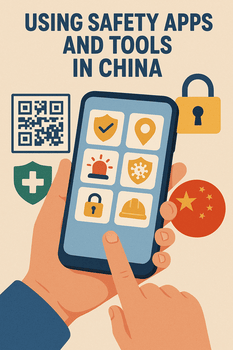
🛡️ Using Safety Apps & Tools in China
Traveling or living in China is an exciting adventure, but it comes with unique challenges—language barriers, digital restrictions, and unfamiliar emergency procedures.
This guide goes beyond app recommendations, offering practical advice, highlighting app limitations, and providing resources to help you stay safe and connected.
Understanding Safety in China
China is generally safe, especially in urban areas, with low rates of violent crime (US State Department).
However, travelers face challenges such as:
- Language barriers
- Unfamiliar customs
- Cybersecurity and privacy concerns
- Regional differences in regulations and services
Key Features to Look for in Safety Apps
| Feature | Why It Matters |
|---|---|
| Real-Time Alerts | Stay updated on weather, emergencies, and traffic |
| Offline Functionality | Essential due to spotty internet or censorship |
| Emergency Services | Quick access to local helplines and guidance |
| User-Friendly Design | Important for non-Chinese speakers |
| Data Privacy | Protects your personal information |
Essential Safety Apps: Pros, Cons, and Access
| App | Main Use | Pros | Cons / Limitations | Download Link / Source |
|---|---|---|---|---|
| Messaging, payments | Ubiquitous, location sharing, translation | Requires Chinese SIM for full features, privacy concerns (NYT) | ||
| Alipay | Payments, health code | Secure payments, health code, safety alerts | Needs Chinese bank account, privacy issues | Alipay |
| Didi Chuxing | Ride-hailing | Safer than street taxis, GPS tracking | May require Chinese phone number, interface not always in English | Didi |
| Pleco | Translation | Offline dictionary, handwriting recognition | Limited voice translation, not a full conversation tool | Pleco |
| AirVisual | Air quality monitoring | Real-time pollution data, global coverage | Some features require internet | AirVisual |
| VPN Services | Internet access | Bypass Great Firewall, encrypts data | Legality is unclear, some VPNs blocked (SCMP) | ExpressVPN, NordVPN |
| Maps.Me / Amap | Offline navigation | Works without internet, detailed maps | Amap mostly in Chinese, Maps.Me less detailed in rural areas | Maps.Me, Amap |
| Red Cross First Aid | Emergency info | Step-by-step first aid, offline access | Not China-specific, may lack local emergency numbers | Red Cross |
| China Train Booking | Train travel | English interface, real-time schedules | Service fees, not official, may not cover all routes | China Train Booking |
App Accessibility and Usability Tips
- Chinese SIM Card: Many apps require a local number for registration and full features.
- App Stores: Google Play is blocked; use Apple App Store (China) or trusted APK sources for Android.
- Language: Some apps have limited English support; familiarize yourself with key icons and functions.
Cybersecurity and Privacy in China
China’s data laws allow government access to user data on local apps (Reuters).
Protect yourself by:
- Using strong, unique passwords and enabling two-factor authentication.
- Avoiding public Wi-Fi without a VPN (see VPN legality).
- Regularly updating apps for security patches.
- Being aware that VPN use is a legal gray area—use at your own risk.
Emergency Procedures and Contacts
| Service | Number / App | Notes |
|---|---|---|
| Police | 110 | Limited English spoken |
| Ambulance | 120 | Know your address in Chinese |
| Fire | 119 | |
| Embassy | Varies | Register with your embassy (List) |
| SOS Apps | Red Cross, 112 China | 112 China not always available; check app store availability |
Tip: Carry a card with your address and emergency contacts written in Chinese.
Practical Safety Tips Beyond Apps
- Register with your embassy for travel alerts and assistance.
- Carry a physical map and written emergency phrases in Chinese.
- Learn basic Mandarin phrases for emergencies.
- Be aware of regional differences—regulations and app access can vary in places like Xinjiang, Hong Kong, and Macau.
- Solo travelers and vulnerable groups should research local customs and safety tips (Travel.State.Gov).
Useful External Resources
- US State Department: China Travel Advisory
- UK FCDO: China Travel Advice
- China Train Booking
- WeChat Official Site
- Alipay International
Conclusion
Staying safe in China requires a blend of the right digital tools and practical preparation.
While apps like WeChat, Didi, and Pleco are invaluable, be mindful of their limitations, privacy implications, and the need for local access.
Combine technology with situational awareness, embassy registration, and basic language skills for a secure and enriching experience in China.