👋 How to Address People in China: Titles, Etiquette & Respect
Understanding how to address people properly in China remains crucial for building respectful relationships in 2025, whether in professional, social, or everyday interactions.
Chinese culture continues to emphasize formality, hierarchy, and age in determining appropriate forms of address, though modern influences are gradually reshaping some traditions.
This comprehensive guide covers key aspects of addressing people in China to help you navigate different situations with confidence.
1. The Importance of Titles and Formality in Modern China
Unlike Western cultures where first-name usage is common, Chinese interactions still emphasize respect through formal titles, though with evolving nuances in different contexts.
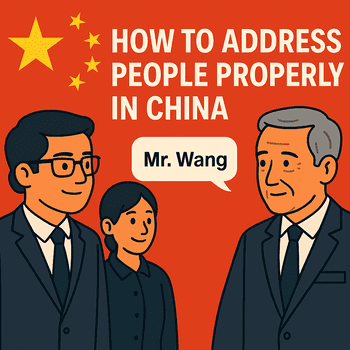
- Use Surnames and Titles: In formal settings, address people by their surname followed by their title.
- Example: Li Laoshi (李老师) – “Teacher Li”
- Example: Wang Jingli (王经理) – “Manager Wang”
- Digital Communication Considerations: As shown in our previous post, even in digital platforms like WeChat and business emails, formal titles remain important for initial communications, though they may be relaxed more quickly than in face-to-face interactions.
- Context Matters: The LC Chinese School notes that “understanding the context in which you’re using titles is crucial. Different situations call for different levels of formality and different ways of addressing people” (LC Chinese School, 2025).
2. Addressing People Based on Age and Hierarchy
Chinese culture continues to place great importance on seniority and hierarchy, which influences how individuals are addressed.
Age-Based Addressing
| Age Group | Male Address | Female Address | Usage Context |
|---|---|---|---|
| Elderly (60+) | 叔叔 (Shūshu) / 老先生 (Lǎo xiānsheng) | 阿姨 (Āyí) / 老太太 (Lǎotàitai) | Both strangers and acquaintances |
| Middle-aged | 叔叔 (Shūshu) | 阿姨 (Āyí) | Casual settings |
| Young Adults | 小哥 (Xiǎogē) | 小姐 (Xiǎojiě)* | Service contexts, casual settings |
*Note: 小姐 (Xiǎojiě) can have negative connotations in some regions. 女士 (Nǚshì) is often safer.
Hierarchy-Based Addressing
- Superiors and Seniors:
- Address them using their surname + title, or use the respectful term Lǎoshī (老师) (for mentors and knowledgeable figures).
- In 2025, many tech companies and startups have adopted flatter hierarchies, but traditional addressing remains important in government, education, and established corporations.
- Peers and Colleagues:
- Use professional titles if applicable.
- If no title is relevant, using “Mr.” (先生, Xiānsheng) or “Ms.” (女士, Nǚshì) remains a safe choice.
3. Common Titles in the Workplace (2025 Update)
In professional settings, using the correct titles fosters mutual respect and professionalism.
Below are key workplace addresses with current usage notes:
| Title | Chinese | Pinyin | Industry Context | Usage Notes (2025) |
|---|---|---|---|---|
| CEO | 首席执行官 / 总裁 | Shǒuxí zhíxíng guān / Zǒngcái | All industries | 总裁 more common in daily use |
| General Manager | 总经理 | Zǒng Jīnglǐ | Traditional businesses | Often shortened to 总 (Zǒng) in familiar settings |
| Director | 总监 | Zǒngjiān | Corporate | Common in marketing, HR departments |
| Manager | 经理 | Jīnglǐ | All industries | Universal across business contexts |
| Team Leader | 团队领导 | Tuándduì lǐngdǎo | Tech, creative industries | Often used in project-based organizations |
| Engineer | 工程师 | Gōngchéngshī | Tech, manufacturing | Highly respected title in technical fields |
| Teacher | 老师 | Lǎoshī | Education, training | Also used as a general respectful title |
“In 2025, while traditional titles remain important, many Chinese tech companies have adopted English titles internally, though Chinese titles are still used in formal external communications,” notes the LC Chinese School’s business title guide.
4. Industry-Specific Titles
Different industries have developed specialized addressing conventions:
Technology Industry
- CTO: 首席技术官 (Shǒuxí jìshù guān)
- Product Manager: 产品经理 (Chǎnpǐn jīnglǐ)
- UX Designer: 用户体验设计师 (Yònghù tǐyàn shèjìshī)
- Data Scientist: 数据科学家 (Shùjù kēxuéjiā)
Finance Industry
- Investment Banker: 投资银行家 (Tóuzī yínhángjiā)
- Financial Analyst: 金融分析师 (Jīnróng fēnxīshī)
- Fund Manager: 基金经理 (Jījīn jīnglǐ)
Healthcare Industry
- Chief Physician: 主任医师 (Zhǔrèn yīshī)
- Attending Physician: 主治医师 (Zhǔzhì yīshī)
- Nurse: 护士 (Hùshi) / 护理师 (Hùlǐ shī)
5. Addressing Friends and Casual Contacts
As relationships develop, Chinese people adopt more familiar ways of addressing each other:
- Given Name + Friendly Title: Adding “Little” (小, Xiǎo) or “Old” (老, Lǎo) before a surname remains common.
- Example: Xiǎo Li (小李) – “Little Li” (for younger peers or close friends)
- Example: Lǎo Zhang (老张) – “Old Zhang” (used endearingly for older friends or colleagues)
- Digital Nicknames: In 2025, online nicknames and WeChat names have become increasingly important in casual and even some professional contexts. These may be completely unrelated to a person’s actual name.
- English Names: Many Chinese professionals now use English names in international business contexts. It’s appropriate to use these when offered, but default to formal Chinese addressing otherwise.
6. Regional Variations in Addressing
Addressing conventions can vary significantly across different regions of China:
| Region | Notable Differences | Examples |
|---|---|---|
| Northern China | More formal, traditional | Stronger emphasis on titles and hierarchy |
| Southern China | Generally more casual | May move to first-name basis more quickly |
| Shanghai/Coastal Cities | More Western influence | Greater acceptance of English names and direct addressing |
| Hong Kong/Macau | Blend of Chinese and Western | May use English addressing patterns more frequently |
| Taiwan | Unique honorifics | Uses some distinct terms of address |
7. Digital Communication and Addressing (2025)
Modern communication platforms have influenced addressing conventions:
- Business Email: Begin with formal titles and gradually relax based on the recipient’s response style.
- WeChat Business: Initial messages should maintain formality; follow the lead of your Chinese counterpart for subsequent communications.
- Video Conferences: Address participants formally at the beginning; the most senior person typically sets the tone for the meeting.
“In digital communications, it’s still better to err on the side of formality initially, especially when connecting with new contacts,” advises Flexi Classes’ 2025 business etiquette guide.
8. Nicknames in Professional vs. Personal Settings
Nicknames (小名, xiǎomíng) play different roles across contexts:
- Professional Settings: Generally avoided in formal business unless explicitly offered. Some colleagues may use nicknames after establishing rapport.
- Personal Settings: Common among friends and family, often affectionate and informal.
- Online Settings: Digital nicknames are increasingly common and accepted across platforms.
9. Recovering from Addressing Mistakes
If you make a mistake in addressing someone:
- Apologize Briefly: A simple “对不起” (duìbuqǐ) acknowledges the error without overemphasizing it.
- Ask for Guidance: “请问我应该怎么称呼您?” (Qǐngwèn wǒ yīnggāi zěnme chēnghu nín?) – “May I ask how I should address you?”
- Adjust and Move Forward: Use the correct form of address going forward without dwelling on the mistake.
Final Thoughts
In 2025, Chinese addressing conventions reflect a balance between traditional respect and modern global influences.
While younger generations and international companies may adopt more casual addressing styles, traditional forms remain important, especially in initial meetings, formal settings, and with older individuals.
According to DigMandarin’s 2025 guide, “Showing respect for Chinese people’s senior titles and hierarchy levels remains essential for giving face, even as some aspects of business culture evolve.”
Understanding these nuances demonstrates cultural awareness and helps build stronger relationships across both traditional and contemporary Chinese contexts.