
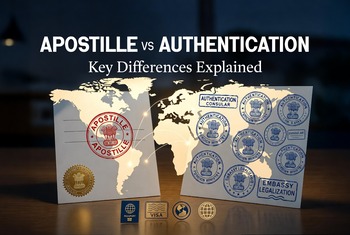
Apostille vs Authentication: Key Differences Explained
As a China expat living in Beijing, Shanghai, Guangzhou, or anywhere across the country, you quickly discover that legalizing foreign documents is an unavoidable part of life.
Whether you’re applying for a Z visa or work permit, registering a marriage with a Chinese partner, enrolling children in international schools, purchasing property, opening a bank account, or handling family reunification, your home-country documents almost always need official certification before Chinese authorities will accept them.
Two primary methods dominate this process:
- Apostille
- Authentication
Understanding “apostille vs authentication” is now more important than ever for China expats.
Since China officially joined the Hague Apostille Convention on 7 November 2023, the rules have simplified dramatically for most expats from participating countries.
An apostille is a streamlined certification created under the 1961 Hague Convention that simplifies recognition of public documents between member countries.
Authentication (also called consular legalization) remains the traditional multi-step process required only when dealing with non-Hague countries.
This comprehensive guide is written specifically for China expats. You will learn the historical context, detailed processes tailored to life in China, key differences, real-world expat examples, costs in RMB and USD, timelines that fit busy expat schedules, and practical tips from those who have already navigated the system.
By the end, you will confidently know exactly which method your situation requires and how to complete it efficiently—whether your documents come from the US, UK, Australia, Canada, Europe, or elsewhere.
The stakes are real. A properly apostilled degree and police certificate can fast-track your work permit approval through the Foreign Expert Bureau.
A missing apostille or incorrect authentication can delay your residence permit by weeks or even force you to restart the entire visa process.
With China now part of the Hague Convention alongside over 125 other countries (including the US, UK, most EU nations, Australia, Japan, and South Korea), the choice between apostille and authentication directly impacts millions of expats annually.
Let’s break it all down so your documents travel smoothly and your China life stays on track.
What is an Apostille?
An apostille is a specialized certificate that authenticates the legitimacy of a public document so it can be recognized in China (and other member countries) without further consular involvement.
The term comes from the French word meaning “certification.” It was introduced by the Hague Convention of 1961.
History and Purpose of the Hague Convention for China Expats
The Hague Conference on Private International Law created the convention to eliminate the old, cumbersome chain of certifications.
Before China’s accession in 2023, foreign documents often required notarization, state/provincial certification, national foreign ministry approval, and then Chinese embassy or consulate legalization in your home country.
This “legalization chain” was expensive, slow, and frustrating for expats.
The apostille simplifies everything to a single standardized certificate attached to or accompanying your original document.
It verifies that the signature, seal, or stamp is genuine and that the signer had authority.
Once apostilled in your home country, the document is automatically accepted in mainland China without any Chinese embassy step.
Hong Kong and Macao have long operated under the convention, and mainland China joined in 2023, making life significantly easier for expats.
The convention applies to public documents such as birth, marriage, and death certificates, educational diplomas and transcripts, police/criminal record certificates, court documents, and notarial acts.
These are exactly the documents China expats need most for work permits, family visas, and permanent residence applications.
How Apostille Works in Practice for China Expats
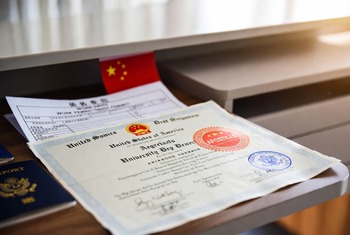
The process is straightforward and happens entirely in your home country before you (or your documents) arrive in China.
For US-issued documents, the Secretary of State in the issuing state handles most vital records and notarized documents; federal documents like FBI background checks go through the U.S. Department of State.
Similar competent authorities exist in the UK (Foreign, Commonwealth & Development Office), Australia (DFAT), Canada (provincial and federal offices), and across Europe.
The apostille itself is usually a single page with standardized fields, securely attached to your document.
Once you have it, you simply send the package to China. No Chinese consulate visit is required anymore for Hague-member documents.
Speed is a major advantage for busy expats. Many services process apostilles in days or weeks with expedited options.
You can even handle everything remotely while still living in China or before your move.
Benefits and Limitations of Apostille for China Expats
Apostilles save time, cut bureaucracy, and reduce costs compared to the old system.
Since China joined the convention, most expats from participating countries now complete the entire process in their home country and ship documents directly to their employer, agent, or Chinese authorities.
This has eliminated the previous headache of booking Chinese embassy appointments abroad.
Limitations remain: Apostilles only work between Hague member countries. The certificate verifies authenticity of signatures and seals but not the truthfulness of the document’s content. Some Chinese authorities may still require a certified Chinese translation alongside the apostilled document.
In real-world expat life, an apostilled marriage certificate lets you register your marriage at the local civil affairs bureau without extra steps.
An apostilled degree and criminal record certificate are now standard requirements for most work permit applications.
What is Document Authentication?
Document authentication refers to the traditional, multi-step legalization process still required for documents from non-Hague Convention countries or in rare exceptional cases.
It is sometimes called consular authentication or full embassy legalization.
The Traditional Legalization Process
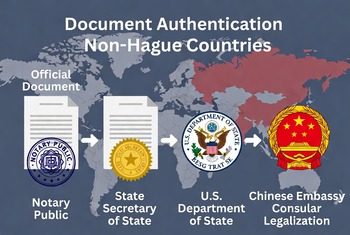
Authentication starts with notarization (if needed), followed by state/provincial certification, national-level authentication (e.g., U.S. Department of State), and finally legalization by the Chinese embassy or consulate in your home country. Each authority vouches for the previous one, creating a long verifiable chain.
When Authentication is Required for China Expats
You only need full authentication if your home country is not a Hague member (check the latest HCCH list—most popular expat source countries are members).
Even after China’s accession, a small number of non-member countries still require the complete chain ending with Chinese consular legalization.
Certain highly specialized documents or specific Chinese government departments may occasionally request extra steps, though this is becoming rare.
Advantages and Challenges of Authentication
Authentication provides universal applicability and multiple layers of verification.
However, it is slower (often 4–12 weeks or more), more expensive due to multiple fees and embassy appointments, and higher risk of errors.
Many China expats hire professional document services to manage the complexity and avoid costly rejections.
In practice, expats from non-Hague countries use authentication for work permits or family visas, while the vast majority now benefit from the simpler apostille route.
Key Differences Between Apostille and Authentication
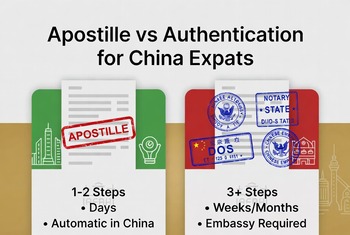
The core of “apostille vs authentication” for China expats comes down to simplicity, speed, and whether your home country participates in the Hague Convention. Here is a clear comparison:
| Aspect | Apostille vs Authentication |
|---|---|
| Applicable Countries | Apostille: Hague Convention members (125+ nations, including China since 2023) Authentication: Non-Hague countries |
| Number of Steps | Apostille: Usually 1-2 (home country authority only) Authentication: 3+ (notary/state, national, Chinese embassy) |
| Processing Time | Apostille: Days to a few weeks Authentication: Weeks to several months |
| Cost | Apostille: Generally lower (¥200–800 RMB equivalent) Authentication: Higher due to multiple fees and embassy costs |
| Required Authorities | Apostille: Home country Secretary of State or equivalent Authentication: Home authorities + Chinese embassy/consulate |
| Document Recognition in China | Apostille: Automatic acceptance for work permits, visas, etc. Authentication: Required only for non-Hague documents |
This table shows why apostille has become the default for the vast majority of China expats since 2023.
Apostille eliminates the Chinese embassy step entirely for member countries, saving significant time and money while you settle into life in China.
Additional differences include standardization: apostilles follow a uniform international format, while authentication certificates vary.
Apostilles are attached directly; authentication often involves separate certificates at each stage.
When to Use Apostille vs Authentication as a China Expat
For almost all China expats from Hague countries (US, UK, EU, Australia, Canada, etc.), apostille is the correct and only required choice.
First, confirm your home country is a member—then get the apostille there and send it to China.
Use authentication only if your documents come from a non-Hague country.
Timing is critical: start the process early because work permit and residence applications have tight deadlines.
Budget also favors apostille.
Hybrid situations exist. Some expats need documents for both China and a third country.
Always double-check the latest requirements with your employer’s HR, immigration agent, or the specific Chinese bureau handling your case, as local practices can vary slightly between cities.
Step-by-Step Guide to Obtaining an Apostille (for Use in China)
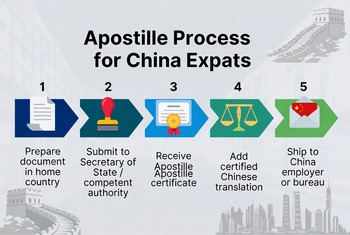
Obtaining an apostille is simple and can usually be done remotely.
Prepare Your Document
Use originals or certified copies with clear signatures and seals. Notarize private documents first if required by your home country.
Determine the Competent Authority
Contact the Secretary of State (US), FCDO (UK), DFAT (Australia), or equivalent in your home country. Federal documents go through national authorities.
Complete Required Forms
Fill out request forms and pay fees (many offices now offer online portals).
Submit Your Request
Mail documents or use an expedited courier service. Professional expat document services can handle everything for you.
Receive and Verify the Apostille
Check that the apostille is securely attached and correctly references your document.
Ship the package to your Chinese employer, agent, or directly to the relevant bureau. Many expats also get a certified Chinese translation at this stage.
Step-by-Step Guide to Obtaining Authentication (for Non-Hague Documents)
This longer process requires careful coordination.
Notarize if Necessary
Begin with a qualified notary in your home country.
Obtain State-Level Certification
Submit to the relevant state or provincial authority.
Secure National Authentication
Forward to your country’s foreign ministry or department of state.
Complete Chinese Embassy or Consulate Legalization
Schedule an appointment at the Chinese embassy/consulate in your home country (or use a courier).
Pay fees and receive the final stamp.
Note: This step is no longer needed for Hague-member documents.
Final Review
Inspect all seals before shipping to China.
Track every step carefully—delays between agencies are common.
Common Documents China Expats Need Apostilled or Authenticated
The most frequent documents include:
- Police/criminal record certificates (mandatory for work permits)
- Highest degree and transcripts (for Foreign Expert Certificate)
- Birth and marriage certificates (family reunification, spousal visas)
- Divorce decrees or court orders
- Notarized powers of attorney or company documents
The choice between apostille and authentication depends on your home country’s Hague status, not the document type.
Costs, Timelines, and Practical Tips for China Expats
Costs vary:
- Apostille fees typically range from US$20–100 (≈¥150–700 RMB) per document plus shipping.
- Authentication adds embassy fees that can reach several hundred dollars per document.
Timelines:
- Apostille usually 1–4 weeks
- Authentication 4–12+ weeks.
Start early—many expats begin the process while still in their home country.
Practical tips from seasoned China expats:
- Always verify current requirements on official Chinese government sites or with your local Entry-Exit Bureau.
- Use trackable DHL/FedEx for all shipments to China.
- Hire a reliable document service if you have multiple documents or tight deadlines.
- Get certified Chinese translations (many Chinese authorities require them).
- Keep digital and physical copies of everything.
- Double-check city-specific rules—Shanghai and Beijing sometimes have slightly different preferences.
Common mistakes to avoid: Sending photocopies instead of originals, skipping translations, or assuming old pre-2023 rules still apply.
Real-World Examples and Case Studies for China Expats

Consider Alex, a US teacher moving to Shanghai for a new job. He apostilled his degree, transcripts, and FBI background check through his state Secretary of State.
The documents arrived in China ready for his work permit application—no Chinese embassy visit needed.
The entire process took under three weeks and saved him hundreds of dollars.
In contrast, Maria from a non-Hague country needed full authentication for her marriage certificate and police record.
The extra Chinese consulate step added six weeks and extra cost, but she successfully registered her marriage in China.
Business expats often handle batches of apostilled corporate documents for setting up WFOEs or representative offices.
These examples show how proper planning prevents visa delays and keeps your China adventure moving forward.
Frequently Asked Questions
Yes. Since November 2023, an apostille from your home country is sufficient for most documents used in work permits, Z visas, and residence permits.
No. You must complete full authentication including Chinese embassy legalization.
Usually 1–4 weeks depending on your home country and whether you choose expedited service.
Almost always yes. Many Chinese authorities require a certified translation by a qualified translator or agency.
Common causes include missing translations, expired documents, or mismatched details. Professional services can help correct and resubmit quickly.
Yes. As a China expat, you can notarize Chinese documents at a local notary office (公证处) and then obtain an apostille through China’s designated authorities (usually the Ministry of Foreign Affairs or authorized offices).
Check the official HCCH website or your home country’s foreign ministry site.
Sources and External Links
| Resource | External Link |
|---|---|
| U.S. Department of State Authentications | https://travel.state.gov/content/travel/en/records-and-authentications/authenticate-your-document.html |
| China Ministry of Foreign Affairs (Apostille info) | https://www.fmprc.gov.cn/ |
| Hague Conference on Private International Law (HCCH) | https://www.hcch.net/en/states/hcch-members |
| Chinese Embassy Apostille Notices | https://cs.mfa.gov.cn/wgrlh/lsrz/lsrzjjs/ |