
🏢 Chinese Workplace Culture for Western Expats in China
Understanding Chinese workplace culture is essential for Western professionals aiming to succeed in China.
Rooted in centuries of history, traditions, and values, the Chinese workplace operates on principles that may differ significantly from Western norms.
This guide explores the key aspects with real examples from my nearly two decades in Shanghai.
Introduction to Chinese Workplace Culture
Chinese workplace culture emphasizes collectivism, harmony, and respect for hierarchy, contrasting with the individualism often seen in Western workplaces.
These values influence everything from how decisions are made to how feedback is given.
My experience: When I first arrived in Shanghai in the mid-2000s, I made the classic Western mistake of being too direct in meetings. I quickly learned that what I saw as “honest feedback” was often perceived as disruptive. Over time, I adapted — and it made a huge difference in building trust.
The Importance of Guanxi (关系)
Guanxi refers to networks of relationships built on trust, respect, and reciprocity.
In China, who you know and how well you maintain those relationships often matters as much as (or more than) your formal qualifications.
How to Build Guanxi — Practical Tips:
- Show Respect and Humility — Acknowledge experience and status genuinely.
- Practice Reciprocity — Small favors and consistent follow-through build long-term trust.
- Be Patient — Real guanxi takes months or years, not days.
Real story from Shanghai:
As a parent of a child in a local public middle school, I spent nearly a year quietly building relationships with teachers and the class parent group before I ever needed help with a school issue.
When a minor problem arose, the guanxi I had invested in meant the conversation happened privately and constructively — no loss of face for anyone.
Western parents who only appeared when there was a problem often struggled more.
External resource: Harvard Business Review on Guanxi
Hierarchy and Structure in the Workplace
Chinese workplaces tend to be more hierarchical than many Western environments.
Respect for authority and the chain of command is expected and helps maintain harmony.
Key Tips for Navigating Hierarchy:
- Defer to superiors in public settings.
- Use formal titles and surnames (e.g., “Director Wang” or “Teacher Li”).
- Express disagreements indirectly and privately when possible.
My experience as a parent and professional:
In school parent-teacher meetings, I learned to let the homeroom teacher lead and to raise concerns gently through private WeChat messages rather than in group settings.
Challenging a teacher openly in front of other parents would have damaged the relationship permanently.
The same principle applies in most professional environments I’ve worked in.
The Concept of Face (面子 – Mianzi)
Mianzi represents a person’s reputation, dignity, and social standing.
Protecting your own face and giving face to others is central to smooth interactions.
How to Maintain and Give Face:
- Praise publicly, criticize privately — Never embarrass someone in front of colleagues.
- Acknowledge contributions — Small public recognition goes a long way.
- Avoid confrontation — Resolve conflicts discreetly, often through intermediaries.
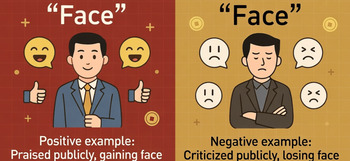
A face-saving moment I witnessed:
During a project discussion years ago, a colleague made a clear error in front of the team.
Instead of correcting him publicly, our manager said, “That’s an interesting perspective — let’s review the data together afterward.”
The colleague fixed the issue privately and the team harmony remained intact.
I’ve used similar approaches successfully with both colleagues and school staff.
External resource: BBC article on Face in Chinese culture
Communication Styles in the Chinese Workplace
Chinese communication tends to be more indirect and context-heavy to preserve harmony.
Western directness can sometimes come across as aggressive.
Tips for Effective Communication:
- Read between the lines and pay attention to non-verbal cues.
- Use softer language (“perhaps we could consider…” instead of “this is wrong”).
- Follow up important verbal discussions with WeChat messages for clarity.
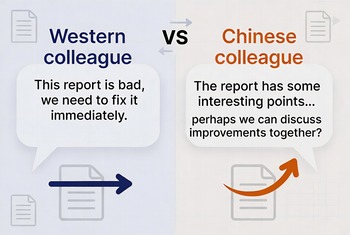
Personal lesson:
Early on, I would send blunt emails when I was frustrated.
The responses were polite but distant. Once I started using more indirect phrasing and giving people an easy way to agree without losing face, cooperation improved dramatically.
In school communications with teachers, framing requests as “I wonder if there’s a way we can support the class together…” has worked far better than direct demands.
Work Ethic and Attitude
Chinese workplaces often value diligence, long hours, and collective success over individual heroics.
Key Elements:
- Long hours are still common in many sectors (though this is slowly changing with younger generations).
- Team success is usually prioritized.
- Showing willingness to learn and contribute extra effort builds respect.
From my life in Shanghai:
Balancing work with raising a child in the local school system taught me that many Chinese colleagues and parents operate with an incredibly strong sense of duty.
Understanding this helped me adjust my own expectations around response times and availability.
It also made me more empathetic when colleagues had to prioritize work during key periods.
Business Etiquette in China
Meetings and Negotiations
- Be punctual.
- Prepare thoroughly.
- Respect seating arrangements (senior person usually sits facing the door or in the center).
Gift-Giving
- Choose thoughtful, appropriate gifts (avoid clocks, sharp objects, or overly expensive items that could create obligation).
- Present and receive gifts with both hands.
- Timing matters — often at the beginning or end of a meeting.
External resource: China Briefing Business Etiquette Guide
Adapting to Chinese Workplace Norms — What Actually Worked for Me
Learning the Language
Basic Mandarin and key workplace phrases make a big difference.
Even if your Chinese isn’t fluent, the effort is appreciated and helps build guanxi.
Tools I recommend: Duolingo for basics + HelloTalk for real conversation practice with locals.
Cultural Sensitivity & Long-Term Mindset
After 20 years, the biggest lesson is this: Relationships come first. Technical skills matter, but trust and harmony often determine real success and opportunities in China.
One thing I still get wrong sometimes: I occasionally slip back into overly direct communication when stressed. The difference now is that I recognize it quickly and repair the relationship privately afterward.
Challenges and Evolving Trends (2026 Perspective)
Traditional values like guanxi, hierarchy, and face remain very much alive.
However, younger professionals (especially in international companies and tech) are influenced by global practices and sometimes push for more merit-based and direct communication.
Multinational teams in Shanghai often operate in a hybrid space — blending Chinese harmony with Western directness.
The most successful expats I know are those who can flexibly switch between both styles depending on the context and people involved.
Conclusion
Thriving in a Chinese workplace as a Western expat requires understanding and respecting core values like guanxi, hierarchy, indirect communication, and the importance of face — while bringing your own strengths.
The good news? Once you invest in real relationships and show cultural sensitivity, doors open that would otherwise stay closed.