📉 Demographic Changes & China’s Permanent Residence System
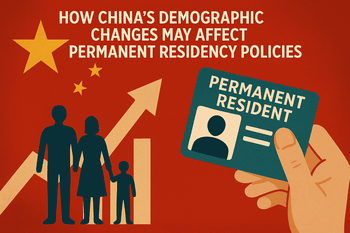
China stands at a demographic crossroads. After decades of rapid growth and urbanization, its population has begun to age and shrink.
Birth rates are near historic lows, the workforce is contracting, and urban centers grapple with attracting and retaining talent.
In response, Beijing and provincial authorities may adjust permanent residency (PR) rules to bolster the labor pool, incentivize skilled migrants, and stabilize local economies.
This post unpacks the key demographic trends, explores current PR policies, examines proposed changes, and assesses their potential impacts on migrants, employers, and China’s global competitiveness.
1. China’s Demographic Landscape
Over the past decade, China’s total fertility rate fell to around 1.3 births per woman, well below the replacement level of 2.1.
The National Bureau of Statistics reports a 350,000 decline in the working-age population (15–59) in 2023, marking the fourth consecutive annual drop.
Simultaneously, the share of citizens aged 60+ rose to 18.9%, putting pressure on pension systems, healthcare services, and social support networks.
Demographic Trends at a Glance:
| Indicator | Latest Value | Trend |
|---|---|---|
| Total Fertility Rate | 1.3 births/woman | Downward |
| Working-age Population (15–59) | 880 million | –0.04% YoY |
| Population 60+ | 18.9% of total | Upward |
| Urbanization Rate | 65.2% | +0.5 pp YoY |
Sources: National Bureau of Statistics of China
2. Existing Permanent Residency Framework
China’s “Green Card”—the Foreign Permanent Residence Permit—remains highly restrictive.
Eligibility categories include:
- Investors: Minimum investment of RMB 2–300 million in key industries
- Senior Executives/Experts: High-level managers or R&D professionals with qualifications recognized by Chinese authorities
- Chinese Descendants: Spouses and dependents of PR holders or citizens
- Talents under Specific Programs: “Thousand Talents Plan,” regional talent schemes
Despite eligibility tiers, issuance is limited—just over 15,000 PR cards granted in 2022 across 1.4 million residence permit holders.
By comparison, the U.S. green card issuance exceeds 1 million annually.
3. Drivers for Policy Reform
Three core factors propel the push to relax PR restrictions:
- Labor Shortages: Advanced manufacturing, tech, eldercare, and service sectors cite acute talent gaps.
- Innovation & Competitiveness: To achieve “dual circulation” and upgrade value chains, China needs foreign experts in AI, biotech, green energy.
- Urban Revitalization: Tier-2/3 cities compete to lure migrants from coastal hubs, easing hukou (household registration) and residency to boost local economies.
4. Potential Changes to PR Rules
Analysts and local governments propose several reforms:
| Reform Proposal | Description | Status |
|---|---|---|
| Points-based System | Award points for education, skills, Chinese proficiency | Trial in Shanghai, Shenzhen |
| Lower Investment Thresholds | Reduce capital requirements for business applicants | Under consideration |
| Simplified Application Process | Online submissions, shorter review cycles | Pilot phases |
| Family Reunification Extensions | Broader spousal/dependent inclusion | Local trials |
| Reciprocal Rights | Equate foreign PR rights with those of Chinese abroad | Policy discussions |
These measures aim to broaden the talent base while maintaining control over immigration scale and quality.
5. Economic & Social Implications
Economic Upsides:
- Talent Retention: Skilled migrants likely to stay longer, invest locally, and share expertise.
- Consumption Boost: Permanent residents contribute to housing, education, and services demand.
- International Ties: PR holders often act as conduits for trade and bilateral cooperation.
Social Considerations:
- Integration Policies: Language training, cultural exchange, and community outreach needed to foster social cohesion.
- Urban Services: Education and healthcare systems must prepare for a more diverse population.
- Hukou Reform Linkages: Broader residency rights may pressure local governments to adjust permanent hukou issuance.
6. Challenges & Considerations
- Political & Security Concerns: Striking balance between openness and guarding strategic sectors.
- Regional Disparities: Wealthier coastal cities adapt faster; interior regions may lag.
- Public Sentiment: Rising nationalism and job market anxieties can fuel resistance to foreign PR expansion.
7. Outlook & Recommendations
While China’s demographic trends necessitate policy shifts, the pace will likely be cautious.
Expect continued pilot programs in gateway cities (Beijing, Shanghai, Shenzhen) before nationwide rollout.
Key recommendations:
- Stakeholder Engagement: Consult businesses, universities, and civil society on eligibility criteria and integration services.
- Data Transparency: Publicly track PR issuance, labor market impacts, and social metrics.
- Holistic Reforms: Align PR changes with hukou, tax, and social security systems for seamless resident transitions.
With thoughtful design, permanent residency reform can help China navigate its demographic challenges, spur innovation, and strengthen its global ties.
8. References
- National Bureau of Statistics of China, “Statistical Communiqué on National Economic and Social Development 2023,” June 2024.
- Ministry of Public Security of the People’s Republic of China, “Foreign Permanent Residence Permits Issued in 2022,” March 2023.
- Business Standard, “In China’s ‘war for people’, cities ease residency rules to invite migrants,” Oct. 28, 2024.