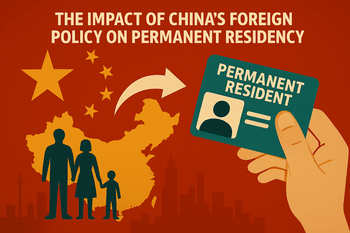
🌐 Foreign Policy Impact on China Permanent Residence
China’s evolving foreign policy has far-reaching implications for its domestic immigration framework.
As Beijing transitions from a “closed” to a more “open” posture on the world stage, its permanent residency (“green card”) system is being reshaped to align with diplomatic priorities, economic partnerships, and talent acquisition goals.
This article unpacks how key elements of China’s foreign policy influence eligibility, issuance, and benefits of Chinese permanent residency, offering expats, investors, and high-skilled professionals a clear roadmap to navigate the changing landscape.
1. China’s Foreign Policy 2.0: From Isolation to Integration
Since the late 2010s, China has gradually shifted from a defensive “hide one’s capabilities” stance towards a proactive global engagement strategy.
Under President Xi Jinping, Beijing has:
- Emboldened multilateral forums (e.g., Asian Infrastructure Investment Bank).
- Deepened bilateral ties via mega-projects under Belt and Road.
- Positioned itself as a hub for innovation through “Made in China 2025.”
These initiatives necessitate attracting foreign talent, capital, and stable expatriate communities—key drivers behind loosening permanent residency requirements for select foreign nationals.
2. Evolution of China’s Permanent Residency Framework
China introduced its formal “Chinese Permanent Residence” system in 2004.
Initially restrictive—focusing on family reunification and sporadic “outstanding foreign talent”—it has since expanded:
- 2004–2015: ~5,000 green cards issued; strict income, residence, and background thresholds.
- 2016: Pilot zones (Shanghai, Guangdong) tested relaxed criteria for high-investment applicants.
- 2017–2023: Inclusion of foreign spouses of Chinese citizens, high-level professionals in high-tech parks, and Belt and Road contributors.
Key eligibility pillars now include:
- Investment/M&A: Minimum RMB 5 million investment, three years’ holding.
- Employment: Senior managerial or specialized roles at Fortune 500 or government-approved entities.
- Exceptional Talent: Recipients of national awards, esteemed researchers, arts & culture figures.
3. Key Foreign Policy Initiatives Affecting PR
China’s diplomatic and economic strategies directly inform who qualifies for PR—and why.
3.1. Belt and Road Initiative (BRI)
BRI spans 140+ countries, financing transport corridors and industrial parks.
To incentivize long-term project leadership and technical experts, China:
- Offers expedited PR interviews for BRI project managers.
- Waives minimum residence for contractors exceeding RMB 100 million in project value.
3.2. “Made in China 2025” & High-Tech Zones
Ambitious tech upgrade plan targeting semiconductors, AI, biotech.
Result:
- Special PR quotas in National Innovation Demonstration Zones.
- Fast-track for foreign specialists holding patents or publications in priority fields.
3.3. RCEP and Regional Talent Flows
With RCEP’s implementation, ASEAN professionals find streamlined visa-to-PR pathways in designated Free Trade Zones:
- Reduced work permit renewal cycles from 2 years to 5 years.
- Cumulative stay requirements cut by 30%.
4. Statistical Trends & Data
Below is a snapshot of PR issuance trends and category breakdown (2018–2022):
| Year | Total PRs Issued | Investment Category (%) | Talent Category (%) | Family Reunification (%) |
|---|---|---|---|---|
| 2018 | 3,200 | 25 | 50 | 25 |
| 2019 | 5,400 | 30 | 45 | 25 |
| 2020 | 4,800 | 35 | 40 | 25 |
| 2021 | 6,100 | 33 | 42 | 25 |
| 2022 | 7,350 | 30 | 45 | 25 |
Key takeaways:
- Talent-driven PR remains the largest share, reflecting Beijing’s tech ambitions.
- Investment-linked PR hovers at 30%, buoyed by BRI and free‐trade incentives.
5. Case Studies: Diplomacy Meets Residency
- Dr. Maria Johansson (Sweden): AI researcher at Shenzhen AI Lab. After co‐chairing a Sino‐Swedish AI forum, she secured PR within 10 months under “Innovation Zone Fast-track.”
- Mr. Ahmed El-Sayed (Egypt): BRI infrastructure engineer whose firm led a $150 million railway upgrade. Eligible for a one‐year residency waiver and welcomed to apply for PR without the usual three‐year minimum stay.
These stories illustrate how foreign policy priorities can override standard residency thresholds to lock in expertise.
6. Challenges, Criticisms, and Compliance
Despite liberalizing trends, hurdles persist:
- Opaque Criteria: Provincial vs. national application discrepancies.
- Changing Diplomatic Tides: Geopolitical tensions can stall visa renewals or PR approval.
- Compliance Burden: Diligence checks on funding sources, tax filings, and security clearances are stringent.
Applicants must maintain impeccable legal, financial, and security records to avoid sudden policy reversals.
7. Future Outlook & Tips for Applicants
As China deepens global engagement, expect:
- Tiered Talent Lanes: Separate fast‐tracks for digital economy vs. traditional infrastructure experts.
- Green Corridor Pilots: Designated cities offering one‐stop PR application centers.
- Digital Residency Trials: Exploring e-residency to attract crypto/blockchain innovators.
Actionable Tips
- Monitor official channels: National Immigration Administration and Ministry of Foreign Affairs websites.
- Leverage local pilot programs in Shanghai Free Trade Zone, Hainan, and Guangdong–Hong Kong–Macao Greater Bay Area.
- Partner with accredited law firms or visa agencies specializing in foreign talent placements.
8. Conclusion
China’s foreign policy not only shapes its international posture but also reconfigures who can become part of its society permanently.
By tying PR incentives to global strategic initiatives—like BRI, “Made in China 2025,” and RCEP—Beijing signals its intent to integrate chosen foreign professionals and investors into the national fabric.
Staying abreast of diplomatic shifts and localized pilots will be crucial for any expat or investor eyeing permanent residency in China’s dynamic environment.
9. External Links & Sources
- National Immigration Administration of China – “Permanent Residence” guide: https://www.nia.gov.cn
- Ministry of Foreign Affairs of the PRC – Belt and Road Initiative overview: https://www.fmprc.gov.cn
- State Council – “Made in China 2025” policy document: http://www.gov.cn/zhengce/2025mi
- RCEP Secretariat: https://rcepsec.org