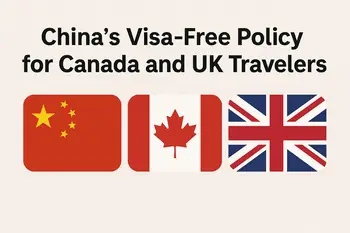
On February 15, 2026, China’s Ministry of Foreign Affairs announced a significant policy shift: starting February 17, 2026, citizens of Canada and the United Kingdom holding ordinary passports will be able to enter China without a visa for stays up to 30 days.
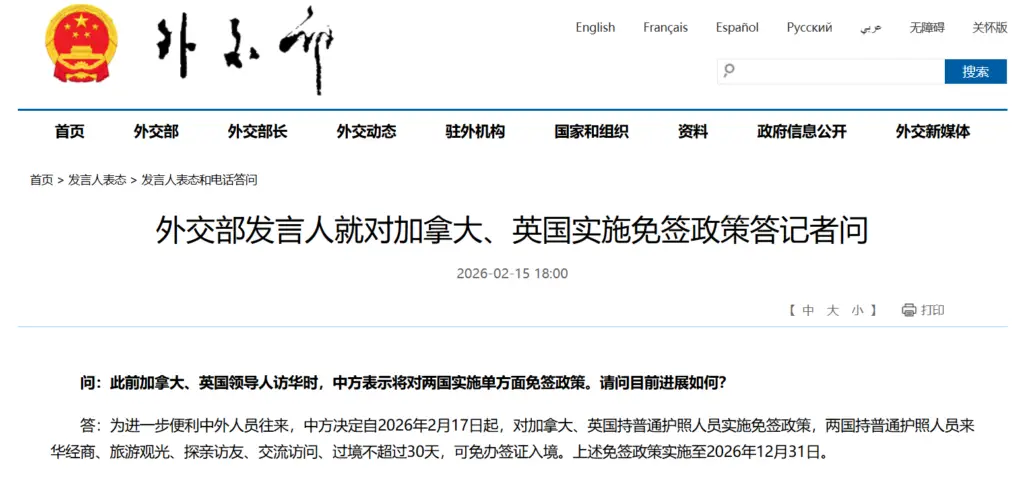
This move, valid until December 31, 2026, marks a milestone in China’s evolving approach to international travel, diplomacy, and economic exchange.
This blog post explores the implications of this policy in depth, covering its diplomatic context, economic impact, tourism potential, and broader geopolitical significance.
Background of the Policy
China’s decision follows earlier discussions during visits by Canadian and UK leaders.
The policy aims to facilitate easier travel for business, tourism, family visits, and cultural exchanges.
Key Details:
- Effective date: February 17, 2026
- Eligible travelers: Canadian and UK citizens with ordinary passports
- Duration: Up to 30 days per entry
- Validity: Until December 31, 2026
Diplomatic Context
China’s visa-free initiative is not merely a travel convenience—it is a diplomatic gesture.
By extending visa-free access to Canada and the UK, China signals openness and a desire to strengthen bilateral ties.
Strategic Goals
- Enhancing trust: Simplified travel fosters goodwill.
- Encouraging dialogue: Easier mobility supports diplomatic exchanges.
- Balancing global relations: China positions itself as a welcoming partner amid shifting global alliances.
Economic Implications
Visa-free travel has direct and indirect economic consequences.
Business Opportunities
- Trade facilitation: Canadian and UK entrepreneurs can explore Chinese markets more easily.
- Investment growth: Reduced bureaucratic barriers encourage foreign investment.
- Networking expansion: Conferences and business trips become more accessible.
Tourism Boost
- Increased arrivals: Easier entry is expected to raise tourist numbers.
- Hospitality sector growth: Hotels, restaurants, and attractions benefit.
- Regional development: Lesser-known Chinese cities may see more visitors.
Tourism and Cultural Exchange
China’s rich cultural heritage—from the Great Wall to modern metropolises—becomes more accessible.
Benefits for Travelers
- Simplified planning: No visa applications mean faster trips.
- Cost savings: Travelers avoid visa fees.
- Flexibility: Spontaneous travel becomes possible.
Benefits for China
- Cultural diplomacy: Visitors gain firsthand experience of Chinese traditions.
- Soft power expansion: Positive impressions strengthen China’s global image.
- Educational exchange: Universities may attract more short-term students.
Comparative Perspective
China’s policy aligns with global trends of easing travel restrictions to stimulate economic and cultural exchange.
| Country | Visa-Free Policy with China |
|---|---|
| Canada | Yes, from Feb 17 to Dec 31, 2026 |
| UK | Yes, from Feb 17 to Dec 31, 2026 |
Challenges and Considerations
While the policy is promising, challenges remain.
Security Concerns
- Monitoring overstays and illegal employment.
- Ensuring border control efficiency.
Policy Limitations
- Temporary validity until December 31, 2026.
- Applies only to ordinary passport holders.
Diplomatic Risks
- Potential criticism from other nations excluded from the policy.
- Balancing openness with national security.
Long-Term Outlook
China may extend or expand the policy depending on its success.
Possible future directions include:
- Adding more countries to the visa-free list.
- Extending the duration beyond 2026.
- Integrating digital travel systems for smoother entry.
Sources
| Source | Link |
|---|---|
| Ministry of Foreign Affairs of the People’s Republic of China | mfa.gov.cn |
| Additional context on global visa policies | UNWTO |
Conclusion
China’s visa-free policy for Canada and UK citizens is more than a travel convenience—it is a strategic move with diplomatic, economic, and cultural implications.
By lowering barriers, China strengthens ties with two major Western nations, boosts tourism, and enhances its global image.
As the policy unfolds, its success will depend on balancing openness with security, and its long-term impact may shape the future of China’s international relations.
About the Author