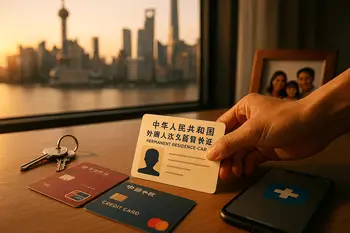
Congratulations on obtaining and starting to enjoy China Permanent Residence Permit benefits: a monumental achievement that transitions you from a temporary visa holder to someone with a stable, recognized legal identity.
Indeed, this document is your key to a simplified, integrated life.
Therefore, this guide serves as your practical handbook for what comes next.
Specifically, we’ll move beyond theory to answer the critical question: “Now that I have it, what do I do?”
To clarify, we’ll cover how to exercise your new rights, fulfill your responsibilities, and strategically plan your future to protect this valuable status.
First and foremost, ensure you have the latest physical card.
For instance, China has introduced a new “5-Star Card” with upgraded security features. So, if you have an older version, learn how to swap it for the new one.
1. Your Core Rights & Privileges
Your Green Card unlocks a level of access and convenience that fundamentally changes your experience in China.
Firstly, you gain Unfettered Residence & Travel. Your right to live in China is now unconditional, allowing you to travel in and out with your valid permit and passport—thus eliminating visa runs and renewal anxieties.
Secondly, you enjoy Complete Professional Freedom, which is arguably the single greatest advantage. Specifically, you can work for any employer without a new work permit, change jobs freely, and start your own company with dramatically reduced bureaucratic hurdles.
Moreover, you achieve Financial & Property Integration:
- For banking, you can open accounts, apply for credit cards, and secure mortgages under local terms, as your PR card is a primary ID.
- Regarding property, you have the right to purchase residential property for self-use. While the process is simpler than for other foreigners, you must still provide proof of residence and tax payments. However, you cannot purchase multiple properties for speculation.
Furthermore, you gain Access to Public Services & Social Welfare. In other words, you are eligible to participate in basic social security and public healthcare systems, contributing and drawing benefits like a Chinese employee.
Additionally, your dependent family members may also be covered.
2. Key Legal & Financial Obligations
However, permanent residence is a privilege with serious responsibilities, as failure to comply can result in fines or revocation.
Of primary importance is your Tax Resident Status. As a result of being a permanent resident, you are almost certainly considered a Chinese tax resident.
This means you must declare your worldwide income if you reside in China for 183 days or more in a tax year and have lived here for six consecutive years.
Similarly, you must manage Social Security Contributions. That is to say, if employed, both you and your employer must make mandatory contributions to fund your future benefits.
Equally critical is Legal Compliance. Consequently, any criminal conviction, particularly related to national security or fraud, will lead to immediate revocation.
Finally, note Residence Reporting obligations. Although the annual check-in has been largely abolished, you must still update your registration with the local PSB within 24 hours of any address change.
3. Deep Dives: Critical Life Areas
3.A. Housing & Property Ownership
Notably, the process to buy a home is streamlined with a Green Card.
The requirements include a valid PR card, at least one year of proven tax payments, and a declaration that the property is for self-use.
Subsequently, the process is similar to a Chinese citizen’s: find a property, sign a contract, pay taxes, and register ownership.
Moreover, you gain access to domestic mortgage loans at local interest rates.
3.B. Healthcare & Insurance Integration
For healthcare, you can enroll in public healthcare (Yibao) through your employer or, in some cities, as self-employed.
Meanwhile, most PR holders maintain international private health insurance for higher-standard care.
Therefore, the two systems can be used complementarily.
In practice, present your PR and healthcare cards at hospitals for the same reimbursement rates as local employees.
3.C. Family & Education
Regarding family, your status simplifies sponsoring your spouse and minor children for long-term residence or even their own PR.
For education, your children have the right to enter the local public system or attend private schools, with the PR card being key for enrollment.
4. Maintaining Your Status: The Essential Rules
Remember, your Green Card is not absolutely permanent and can be lost.
Here’s how to protect it:
- Firstly, consider Physical Presence (The “Soft” Rule). While no strict minimum exists, prolonged absence (e.g., over one to two years) without valid reason can trigger a review upon re-entry.
- Secondly, be aware of Definitive Grounds for Cancellation, such as threatening national security, fraud, criminal conviction, voluntary renunciation, or obtaining permanent residence elsewhere while living there.
- Lastly, manage Life Changes carefully. For example, a divorce soon after obtaining PR through marriage may lead to scrutiny, but stable independent employment and tax history generally secure your status. Similarly, job loss does not affect your status if you maintain lawful income and tax payments.
5. Long-Term Planning: Retirement, Mobility & Future
For retirement, you can retire in China indefinitely and claim your pension if you have made sufficient contributions.
Regarding global mobility, your PR provides a stable base in Asia, facilitating regional travel and business.
Nevertheless, understand that Permanent Residence does not lead to Chinese citizenship, as China does not permit dual citizenship and naturalization is exceptionally rare.
6. FAQ: Daily Life as a Permanent Resident
Q: Do I still need to carry my passport?
A: In practice, your PR card is valid ID for most daily situations. However, legally, foreigners must carry their passport, so always keep a copy handy.
Q: Can I be drafted into the military?
A: No, because military service is tied to citizenship, not permanent residence.
Q: How do I get a Chinese ID card (Shenfenzheng)?
A: You cannot, as the national ID is for citizens only. Instead, your Permanent Residence Card is your equivalent legal identity document.
Q: What happens if I lose my PR card?
A: Immediately report the loss to the local PSB and apply for a replacement, an administrative process that can take several weeks.
Conclusion: Your Checklist & Resource Hub
In summary, you now hold the key to building a long-term life in China, with the responsibility to manage this status wisely.
Your First 90-Day Checklist:
- [ ] Update Your Records with police, bank, and employer.
- [ ] Explore Social Security enrollment.
- [ ] Review Tax Strategy regarding the “6-Year Rule.”
- [ ] Begin Family Planning for dependent visas, if applicable.
- [ ] Secure Important Documents by making copies of your PR card.
Finally, your Chinese Green Card is more than a permit—it’s the foundation for your future.
Accordingly, use this guide to build upon it wisely.
About the Author