
🏠 China Permanent Residence: Eligibility & Application Guide
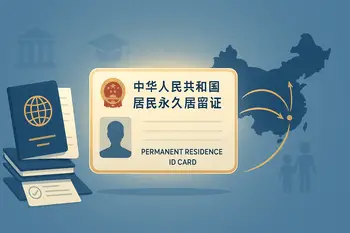
China Permanent Residence Permit, commonly called the “Green Card” is the highest-level residence status granted to foreign nationals.
It represents a fundamental shift from being a temporary visa holder to establishing a stable, long-term legal identity in China.
Established in 2004, the system has evolved to attract global talent, investment, and family reunification.
Holding a Green Card means you have the unconditional right to live and work in China indefinitely, freeing you from the recurring cycles of visa and work permit applications.
Key Distinctions:
- Vs. Work Visa/Residence Permit: These are employer-tied and temporary. The Green Card is personal and permanent.
- Vs. Long-Term Visas: These still require renewal and have activity restrictions. The Green Card does not.
- Vs. The “5-Star Card”: This is a newer, upgraded physical version of the permit. You can learn about upgrading your old card here.
Quick Start: Not sure if you qualify? Jump to our Eligibility Pathways section to find your category.
1. Core Benefits & Advantages
Obtaining permanent residence transforms your experience in China.
Here are the key advantages:
- Unlimited Residence & Hassle-Free Travel: Live in China without duration limits. Enter and exit the country with a multi-entry visa, eliminating the need for constant re-applications.
- Complete Work Freedom: Work for any employer, change jobs, or start your own business without applying for a new work permit. This provides unparalleled career flexibility.
- Integrated Daily Life: Access public services, social insurance (pension, healthcare), and the financial system (apply for mortgages, credit cards) on near-equal footing with Chinese citizens.
- Family Benefits: Your spouse and minor children can apply for their own permanent residence based on family reunification, securing your family’s future in China.
For a deep dive into life after getting the card, including detailed guides on property, taxes, and education, see our companion guide: China Permanent Residence Benefits: Life, Rights, Taxes & How to Keep It.
2. Eligibility Pathways: Which Category Fits You?
You must qualify under one of these primary categories.
Requirements are strict and evidence-based.
Category A: High-Level Talent & Skilled Professionals
Designed for individuals who contribute significantly to China’s economy and development.
- Senior Management/Experts: Senior executives, technical directors, or professors who have held a position in China for at least 4 consecutive years, resided in China for at least 3 of those years, and have a strong tax record.
- Highly-Skilled Workers (Points-Based): Individuals who meet a points threshold based on salary, education, work experience, Chinese language ability, and employment in encouraged sectors.
Category B: Investors & Entrepreneurs
Aimed at attracting significant foreign capital.
- Direct Investors: Individuals who have made a stable and substantial direct investment in China (specific thresholds vary by region and are subject to change—currently often starting at USD $500,000+ over 3 years).
- Key Personnel: Senior management or technical personnel in encouraged foreign-invested enterprises that have generated significant tax revenue and employment.
Category C: Family Reunification
For building family life in China.
- Spouse of a Chinese Citizen/PR Holder: Must be married for at least 5 years, have lived in China for at least 5 consecutive years with stable residence and livelihood.
- Dependents: Minor children or elderly parents (over 60) of a Chinese citizen or PR holder who need support.
For a very specific pathway for retired or disabled overseas Chinese, please see our dedicated article here.
3. The Step-by-Step Application Process
The process is meticulous and can take 6 to 18 months. Patience and precision are key.
Pre-Application Preparation (2-3 Months)
- Self-Assessment: Rigorously check your eligibility against the official criteria for your chosen pathway.
- Document Collection: Begin gathering all required documents (see Section 5). This is the most time-consuming part.
- Document Legalization: All foreign-issued documents (degree, marriage certificate, non-criminal record) must be notarized, authenticated by your home country’s authorities, and then legalized by the Chinese embassy/consulate (or apostilled if from a Hague Convention member).
- Health Check: Undergo a physical examination at a Chinese entry-exit inspection and quarantine bureau authorized hospital.
Formal Application & Review (6-12+ Months)
- Submission: Submit the complete application package in person at the Exit-Entry Administration of the Public Security Bureau in the city where you reside.
- Initial Review: Authorities will check for completeness. Incomplete applications are rejected immediately.
- Investigation & Interview: A thorough background check is conducted. You and your sponsor (employer/spouse) may be interviewed.
- Decision & Approval: The final decision is made by the National Immigration Administration (NIA). You can [check your application status via the NIA mini-program].
Post-Approval
- Receive Notification: You will be notified to collect your approval letter.
- Obtain the Permit: Use the approval letter to apply for the physical Permanent Residence ID Card at the PSB.
- Post-Registration: Update your status with your employer, bank, and other institutions.
4. Essential Documents Checklist
This is a general list. Specific requirements vary by category.
| Document Type | Examples & Notes |
|---|---|
| Application Forms | Completed Application Form for Permanent Residence in China, recent passport-style photos. |
| Personal Identity | Valid passport and all current/past Chinese visas/residence permits. |
| Proof of Eligibility | Talent: Employment certificate, tax records (last 4 years), professional achievement proofs. Investor: Business license, investment verification report, capital audit, tax certificates. Family: Marriage/birth certificate (legalized), spouse’s Chinese ID/PR card, and proof of stable residence. |
| Health & Character | Health examination report (from China). Police Clearance Certificate (no criminal record) from your home country and any country lived in for over 2 years in the last decade. |
| Financial Security Proof | Proof of stable income and assets (Bank statements, and tax payment receipts). A notarized bank deposit certificate of at least RMB 200,000, frozen for over 6 months. If the account is under the spouse’s name, an additional notarized declaration of financial support from them is also needed. |
| Legalized Documents | All foreign documents (degrees, certificates) must follow the notarization > authentication/legalization (or apostille) chain. See our degree authentication guide. |
5. Common Reasons for Denial & How to Avoid Them
- Insufficient or Inconsistent Documentation: Tax records not matching employment dates, gaps in residence proof. Solution: Create a meticulous timeline and cross-check every date.
- Weak Proof of Stable Livelihood: Inadequate tax payments or unverified income sources. Solution: Ensure you are formally employed and paying the highest legally possible tax.
- Criminal or Security Concerns: Any record, even minor offenses, or employment in sensitive sectors, can lead to denial. Solution: Obtain official police clearances and be transparent.
- Failure to Meet Continuous Residence: Breaking the “continuous residence” requirement before applying. Solution: Plan your time in China carefully; avoid long overseas trips during the qualifying period.
- Application Errors: Incorrect forms, missing signatures, untranslated documents. Solution: Double-check everything or hire a professional to review your package.
6. Frequently Asked Questions (FAQs)
Q: How long is the Permanent Residence Permit valid?
A: For adults, it’s typically valid for 10 years and renewable. For minors, it’s usually valid for 5 years.
Q: Can I lose my Permanent Resident status?
A: Yes. Status can be revoked for: residing outside China for an extended period (typically without a valid reason), obtaining it by fraud, engaging in activities harmful to national security, or a criminal conviction. See our maintenance guide for details.
Q: Do I need to speak Chinese?
A: It is not a universal legal requirement, but basic proficiency is highly advantageous for daily life and integration. For some points-based talent schemes, language ability can contribute to your score.
Q: Does PR lead to Chinese citizenship?
A: No. China does not recognize dual citizenship, and naturalization is an extremely rare, separate process granted under exceptional circumstances. PR is a long-term residence status, not a step towards citizenship.
7. Conclusion & Your Next Steps
Securing China Permanent Residence is a challenging but immensely rewarding process that unlocks long-term stability and opportunity.
Your Action Plan:
- Determine Your Pathway: Re-read Section 3 and identify your category.
- Gather Core Documents: Start with your passport, tax records, and legalized degree/marriage certificate.
- Seek Professional Advice (Recommended): Given the complexity, consulting with an immigration lawyer specializing in Chinese PR is highly advisable to review your eligibility and documents.
- Prepare for the Long Haul: Set realistic expectations for the timeline and procedural rigor.
This guide is your roadmap. The journey requires diligence, but the destination—a permanent home in China—is worth the effort.
Ready to learn what life looks like after approval? Explore your rights, responsibilities, and long-term strategy in our comprehensive follow-up guide: China Permanent Residence Benefits: Life, Rights, Taxes & How to Keep It.

(2024-年版.png)